7 Signs Your Sewer Line Is Failing (Sarasota Edition)
Sarasota's rain, sand, and water table stress sewer lines in ways inland cities rarely see. These seven symptoms, taken together, separate a dying sewer line from a simple clog.
Sign 1: Drains Are Slow Throughout the Whole House
One slow bathroom sink is a plumbing annoyance. Every drain in the house running slow at once is a sewer-line message. Your home's drains all converge on a single lateral, the pipe that carries everything from the house to the city main or your septic system. When that shared exit narrows, every fixture upstream feels it, and no single drain feels it first.
The distinction matters because homeowners routinely misread this sign. A whole-house slowdown gets treated as a handful of separate clogs: the kitchen sink gets a treatment, the shower gets a treatment, the tub gets a treatment, and none of it lasts. If two or more fixtures on different branches of your plumbing are sluggish at the same time, stop treating them individually. The bottleneck is not in the fixtures. It is in the one pipe they share.
Why Whole-House Slowness Points Underground
In Sarasota's 1960s to 80s slab subdivisions, Gulf Gate and Bee Ridge are the classic examples, cast-iron drain pipes run under the slab and clay or cast-iron laterals run out to the street. Internal scale builds up inside aging cast iron, narrowing the pipe year after year. A camera inspection on one of these lines often shows a pipe that is half its original diameter in places, with rough scale walls that grab everything flowing past. The result is exactly what homeowners describe: the whole house drains like it is breathing through a straw.
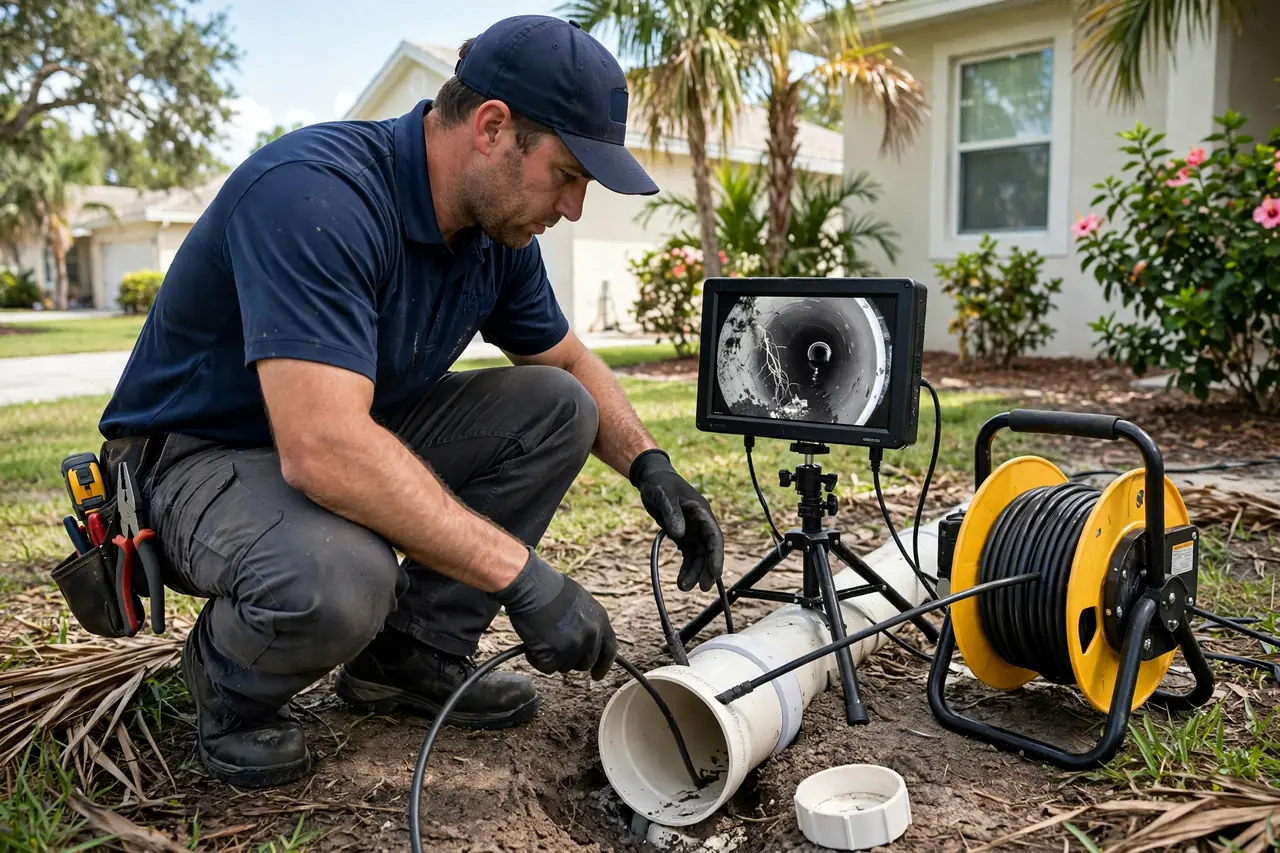
Sarasota's soil accelerates the timeline. Saturated sandy soil loses support under pipes during the rainy season, and pipe sections sag into bellies that hold standing water. Waste settles in the belly instead of flowing through, and the effective drain speed of the entire system drops. A sewer camera inspection shows bellies and scale in real time, you see what the technician sees.
Sign 2: Gurgling Toilets and Bubbling Drains
Gurgling is the sound of a sewer line struggling to vent. When water cannot move freely through a partially blocked or collapsed section, it pushes air ahead of it and pulls air behind it, and that air escapes through the nearest trap, your toilet, your shower drain, your kitchen sink. A toilet that bubbles when the washing machine drains is telling you the main line is restricted.
This is one of the most specific symptoms on this list because ordinary fixture clogs almost never cause cross-fixture gurgling. If your toilet only gurgles when you flush that same toilet, that is a toilet problem. If your toilet gurgles when the dishwasher runs or the shower drains, the problem is in the shared lateral, downstream of all of them. Camera diagnosis pinpoints the restriction, a scale buildup, a root intrusion, a sagging belly, or a collapsed section, so the fix matches the cause.
Don't Ignore Gurgling That Comes and Goes
Intermittent gurgling often follows the water table. During Sarasota's dry months, a cracked joint may sit above the groundwater and vent normally. After the June to September rains lift the water table to near the surface, groundwater infiltrates the crack and narrows the pipe, and the gurgling returns. Homeowners describe it as a seasonal haunting, quiet all spring, talkative all summer. It is not a ghost. It is groundwater in your lateral.
Sign 3: Persistent Sewer Odors Around or Inside the House
Sewer gas has a smell you do not mistake for anything else, and it should never be present in or around a healthy home. Odors surface when the system loses its seal: a cracked lateral lets gas escape into the soil and up through the ground, and a dried or failing trap lets it rise into the house. Persistent odor is the sign people tolerate the longest and should tolerate the least.
Indoor odors after rain are a Sarasota signature. When the seasonally high water table, 0 to 3.5 feet across much of the county, rises around a cracked lateral, groundwater presses into the pipe through cracks and separated joints. The system that was merely cracked becomes actively flooded, and gases pushed ahead of the intruding water find the path of least resistance, sometimes straight into the home. If your house smells worst after the August downpours, the water table is narrating your pipe's condition.
Odors Outdoors Deserve the Same Attention
That warm sewer smell near a particular patch of lawn, or around a cleanout cap in the yard, points to a leak or break underground. Our sewer odor detection traces the source with smoke testing and camera work rather than guesswork. Odor plus any other sign on this list is a strong case for getting a camera in the line.
Sign 4: Unusually Lush Patches of Lawn
A sewer leak is, from your lawn's perspective, free fertilizer delivered on schedule. Wastewater escaping from a cracked or separated lateral feeds nitrogen and moisture into the soil directly above the break, and the grass there grows greener, taller, and faster than the surrounding lawn. One mysteriously thriving stripe or patch, following a line from your house toward the street, is worth a hard look.
This sign shows up in every neighborhood, but the mechanism in Sarasota's sandy soils is worth understanding. Myakka fine sand, Florida's state soil, drains fast when dry, so a slow leak may vanish into the sand without surfacing. What it cannot hide from is the root zone: moisture and nutrients concentrate in the top foot of soil, and the lawn broadcasts the leak. If the lush patch is also slightly spongy underfoot, groundwater is pooling there too, and the leak has company, a crack large enough to let water both out and in.
The Lush Patch Test
Mark the edges of the green patch and watch it for two weeks of normal weather. If it stays green while the rest of the lawn fades, the leak is feeding it continuously, not just after rain. During the rainy season the contrast fades because everything is green, which is why this sign gets noticed most often in spring. A camera inspection confirms whether the lateral under that patch is leaking.
Sign 5: Backups That Return After the Line Is Cleared
The most expensive sign on this list is the pattern nobody budgets for: a drain company clears the line, everything works for a few weeks or months, and then the same backup returns in the same fixtures. Each clearing buys a shorter interval than the last. Homeowners on this treadmill often spend more over two years of repeated clearings than a single repair would have cost.
Why does clearing keep failing? Because clearing removes the symptom, the blockage, without touching the cause. If roots intrude through a cracked joint, the cable cuts the roots and the joint remains cracked; roots return within the season. If cast-iron scale narrows the pipe, the snake punches through and the scale remains; new debris catches on the same rough walls. If a belly holds standing water, nothing about clearing changes the geometry. Hydro jetting cleans far more thoroughly than a cable, but even a jetter cannot fix a pipe that is broken, collapsed, or sagging. At the point where clearings repeat, the honest move is to look inside the pipe instead of clearing it again.
When Clearing Becomes the Wrong Answer
A practical rule: if the same line has been cleared twice in twelve months, stop clearing and start diagnosing. A camera inspection turns the guessing game into footage, you will see the cracked joint, the scale ridge, the sagging section, or the root mass, and the repair conversation starts from evidence. That is exactly how sewer line replacement decisions should be made: after seeing the pipe, not after clearing it a third time.
Sign 6: Backups That Arrive With the Rainy Season
Sarasota's rainy season, June through September, with August the wettest month, delivers about 60 percent of the year's 49 to 53 inches of rain in four months. That is not just weather; it is a stress test for every underground pipe in the county. If your backups reliably show up in July and August and vanish by November, you are watching groundwater overwhelm a compromised lateral.
The mechanism runs in two directions. First, saturated soil and a high water table infiltrate cracked laterals through every joint and crack, and the extra inflow can overload a line that handled the dry season fine. Second, heavy rain softens and shifts the sandy soil around pipes, and settling stresses joints, joint separation that was minor in May becomes a real gap after a week of August storms. The 2024 storms, Debby's inland flooding, then Helene and Milton, taught plenty of Sarasota homeowners that a sewer line can fail as a rain event, not a plumbing event.
The Gulf Gate Pattern
Gulf Gate's 1960s to 80s slab homes are the textbook case: cast-iron drain pipes under slab, clay laterals to the street, sandy soil, and a water table that sits near the surface in summer. Every August, the same houses back up. If your Gulf Gate home joins the August club, a camera inspection before the next rainy season is the move that prevents the next backup. Gulf Gate's neighborhood page walks through the area's specific failure cohort in detail.
Sign 7: An Unexplained Rise in Your Water Bill, or Standing Water That Won't Drain
Sewer laterals carry water away from the house, so they do not directly show up on a water bill, but the symptoms of a failed line do show up in the yard. Standing water that lingers days after rain, in a spot that used to drain, suggests the soil is saturated from below, not from above. A leaking lateral keeps the surrounding soil waterlogged long after the rain stops, and the puddle becomes permanent.
Combine yard pooling with any other sign on this list, especially odors or lush patches, and the picture firms up fast. Standing water alone is a drainage question; standing water plus sewer symptoms is a sewer question. In low-lying areas near Phillippi Creek or Whitaker Bayou, a failed lateral can hold yards soggy through the entire rainy season, and no amount of surface grading fixes a leak three feet down.
Putting the Seven Signs Together
No single symptom on this list diagnoses a failed sewer line by itself. But symptoms cluster. Whole-house slow drains plus gurgling is a restricted lateral. Odors plus lush patches is a leaking lateral. Repeated clearings plus rainy-season backups is a line that is structurally failing. If three or more of these signs describe your home, the next step is not another clearing, it is a camera. When a line is beyond repair, emergency sewer repair handles the failures that cannot wait, and full replacement ends the cycle for good. Call (941) 344-0088.
Published 2026-10-09 · Sarasota Sewer Specialists
Related Sewer Services
Sewer Line Replacement
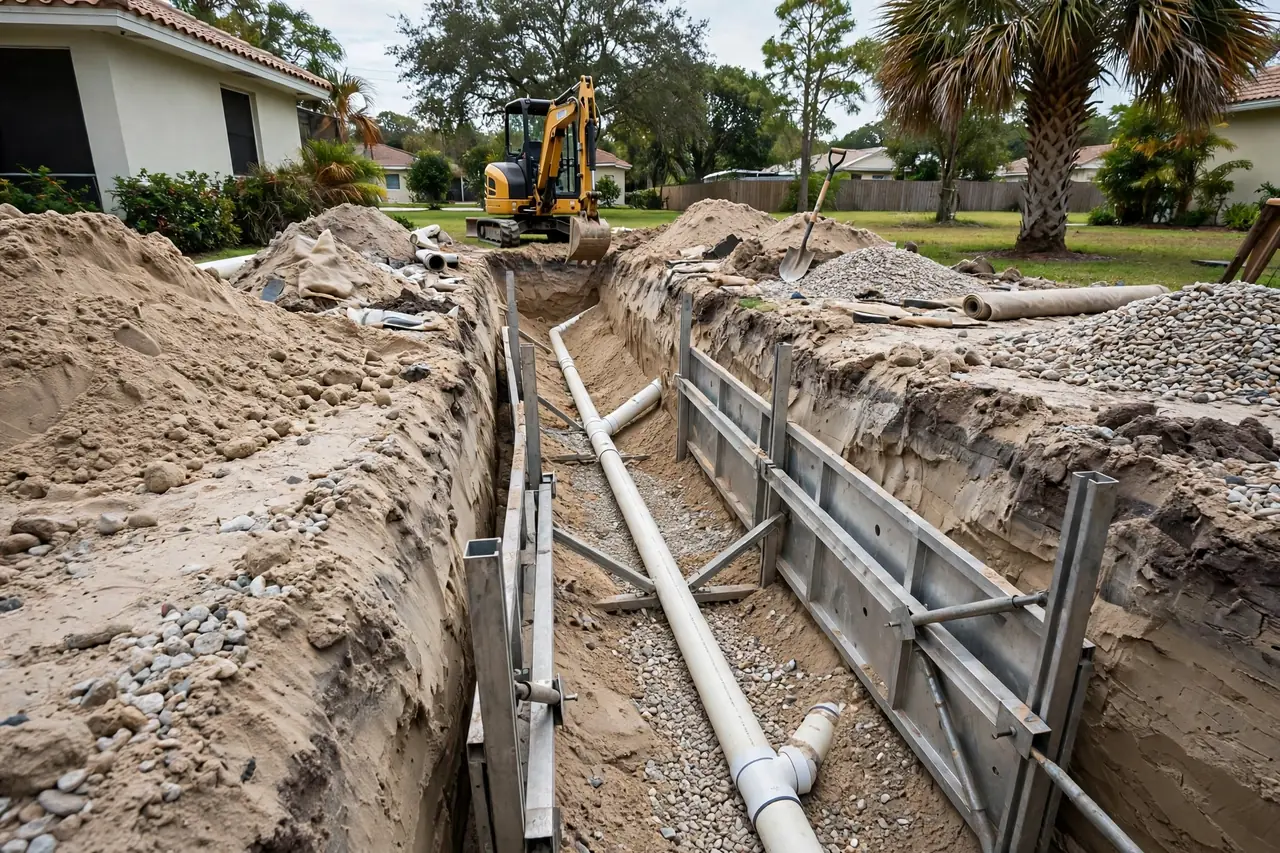
Sewer line replacement in Sarasota, FL by excavation when trenchless won't work: proper grade, modern PVC pipe…
Learn more →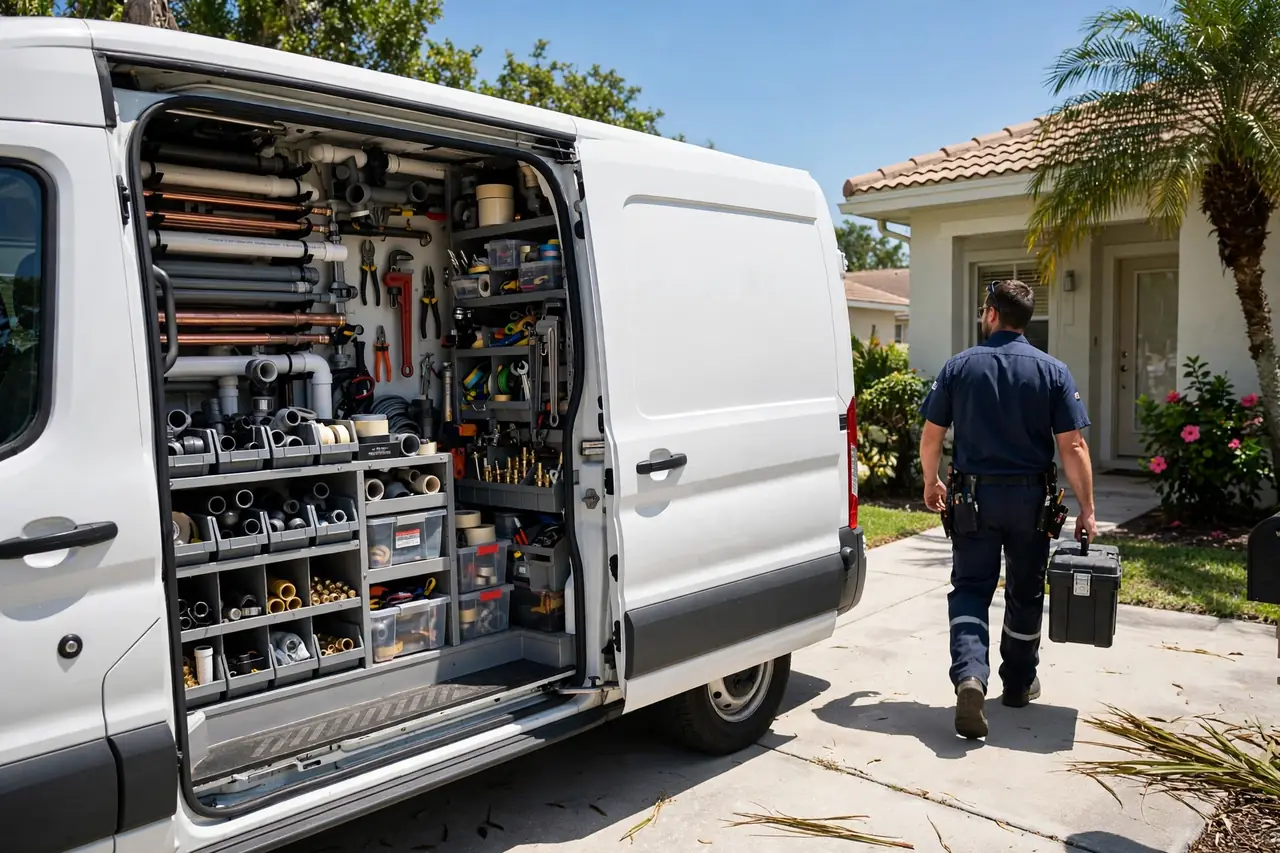
Emergency Sewer Repair
Emergency sewer repair in Sarasota, FL for backups and burst lines. Fast response, camera diagnosis. Call (941…
Learn more →Nearby Service Areas
Frequently Asked Questions
How can I tell the difference between a normal clog and a failing sewer line?
A plunger or a basic drain snake clears a single fixture: a sink, a tub, a toilet. A failing sewer line affects multiple fixtures at once. If two or more drains run slow at the same time, or a toilet bubbles when the washing machine drains, the problem is downstream of your house plumbing, and that is exactly what a sewer camera inspection is built to confirm.
Can a sewer line go bad quickly, or is failure always gradual?
No. Root growth is gradual, but cast-iron corrosion under a slab can cross the line from stable to failing in one rainy season once saturated soil shifts pipe bedding. The August rains put the most stress on the system, so a line that behaved in spring can back up in August. Sudden changes deserve a camera look, not a wait-and-see.
If my drains are just slow in one bathroom, does this article apply?
It is a starting point, not a diagnosis. If several of the signs in this post are showing up together, whole-house slow drains, gurgling, odors, and rainy-season backups, a camera inspection is the right next step. One isolated symptom usually points to a single fixture or branch line, not the main sewer.
Do these signs apply to homes on septic systems?
Sarasota homes on septic systems can show almost identical symptoms when a drainfield struggles, especially in the rainy season when the water table is high. Sarasota County's septic-to-sewer program is actively converting many neighborhoods. A camera inspection tells you whether the problem is in your pipe or your septic system.
What does a sewer camera inspection actually involve?
For a typical home lateral, a camera inspection is a diagnostic visit, not a construction project. The camera runs through a cleanout, the footage is recorded, and you see exactly what the technician sees. No digging happens until you decide the findings warrant it.