Sewer Camera Inspection in Sarasota, FL
An HD sewer camera shows exactly what is happening inside your underground line, roots, scale, bellies, separations, before anyone digs or recommends a repair. It is the smartest first step for any Sarasota homeowner with a sewer concern, and for anyone buying an older home.
Why Diagnosis Comes Before Repair
Every sewer repair method answers a different question. Lining answers cracked pipe. Bursting answers collapsed pipe. Excavation answers lost grade. But none of those methods can tell you which question your line is asking, only a camera can. Recommending a repair without looking inside the pipe is not a diagnosis; it is a guess with equipment attached.
The cost of guessing wrong is real. A line jetted for the third time when the actual problem is a belly will keep backing up, because no amount of cleaning restores slope. A line lined over a collapse will fail, because a liner needs a host to form against. A line excavated and replaced when a simple lining would have done means a torn-up property for nothing. The camera inspection exists to prevent all three mistakes, and it does so for a fraction of what any of them costs in wasted work.
This is why we treat the inspection as the non-negotiable first step of every project. We do not recommend trenchless methods, excavation, or anything in between until we have seen the inside of the line. The footage belongs to you, the findings are explained in plain language, and the repair plan follows the evidence.
What an HD Camera Finds in Sarasota Lines
Sarasota's pipe materials and soil conditions produce a recognizable set of defects. After enough inspections, the patterns are familiar, but each line still has to be seen, because the mix is always its own.
Root Intrusion
Mature live oaks and ficus trees send feeder roots toward the moisture and nutrients leaking from pipe joints. Clay tile laterals in the historic core, Laurel Park, the Rosemary District, Gillespie Park, offer a joint every few feet, and the camera routinely finds root masses wedged into them, sometimes filling the pipe's full diameter.
Cast-Iron Scale and Corrosion
In the 1950s to 1980s tracts and slab subdivisions, the camera shows cast iron in various stages of interior decay: rough scaling that narrows the bore, flaking corrosion, pinholes, and sections where the pipe wall has thinned toward collapse. Gulf Gate and Bee Ridge lines are textbook examples.
Bellies and Standing Water
Saturated sandy soil loses its ability to support pipe, and the line sags. On camera, a belly is unmistakable: the lens drops into a low section where water ponds, with the pipe visible below the waterline on both sides. Bellies are grade problems, cleaning will not fix them, and neither will lining or bursting.
Separations and Offsets
When soil settles or shifts after saturation, joints pull apart or sections shift out of alignment. The camera shows the stair-step where one section no longer meets the next, a snag point for solids and an entry for roots and groundwater.
Collapses and Crushed Sections
The end stage of corrosion or soil pressure: the pipe flattened or caved in, sometimes with soil visible through the break. Collapsed sections mark the boundary between rehabilitation and replacement.
How the Inspection Works
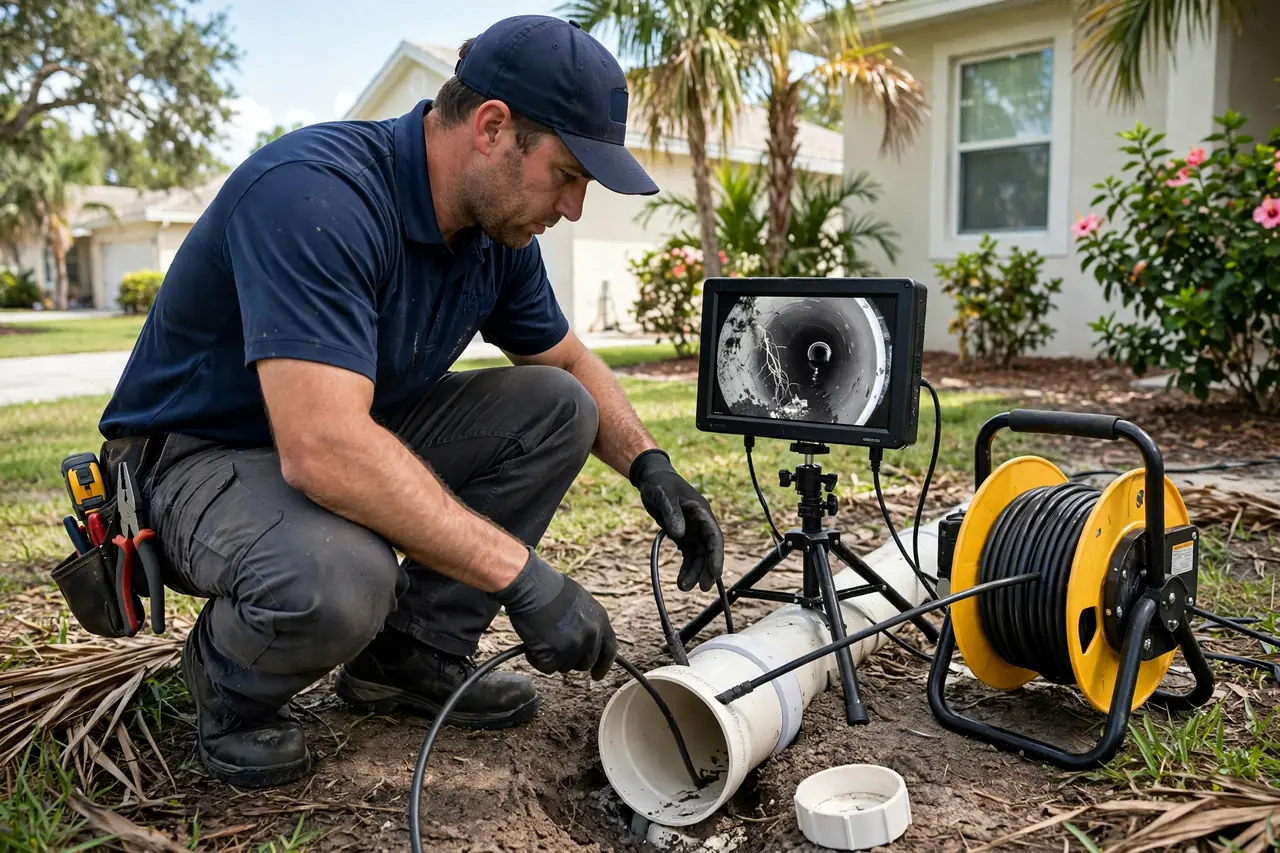
The process is straightforward and requires no digging. The technician locates your sewer cleanout, the capped access pipe typically found near the foundation, in a flower bed, or at the property line, and feeds a flexible push rod into the line. At the rod's tip rides a waterproof camera head with its own lighting, sized to travel through a residential lateral.
Above ground, the technician watches the live feed on a monitor as the camera advances foot by foot through the pipe. The camera head carries a locating transmitter, so at any point the technician can sweep a receiver over the surface and mark exactly where the camera sits: how many feet from the cleanout, how deep below grade. When a defect appears on screen, its position gets marked on the ground, which is how an access pit later lands precisely over the problem instead of approximately near it.
The full run is recorded. The inspection typically covers the lateral from the house to the main, and the recording, along with the technician's notes on what was found and where, is provided to you. The whole visit usually takes well under an hour for a standard residential line.
Reading the Footage: From Images to a Plan
Raw footage is only useful if someone knows what it means. The technician reading your inspection is looking for specific things: the material and condition of the pipe wall, the location and severity of each defect, the presence or absence of standing water, and the overall grade of the line.
What matters is not just the defects but their pattern. Isolated root intrusion at two joints in an otherwise sound clay line is a lining candidate. Roots at every joint plus a belly mid-run is a replacement candidate. Heavy scale through a cast-iron run with the pipe still round is a descaling-and-lining candidate; scale plus a collapsed section is a bursting candidate. The footage turns a vague symptom, "the drains are slow", into a specific, located, measurable condition with a matched remedy.
This is also where honesty enters the process. If the footage shows a line in good condition, we say so, and no repair is recommended. If it shows a problem that trenchless methods cannot fix, we say that too. The camera does not upsell; it shows.
Smart Before Buying a Home
A standard home inspection covers what can be seen from inside the house. The sewer lateral, the most expensive single component of the drainage system, is invisible to it. In Sarasota, where so much of the housing stock sits on 1960s to 1980s cast iron under slab or older clay tile, buying without a sewer camera inspection means buying a question mark buried in the yard.
The stakes are concrete. A collapsed under-slab line or a bellied lateral discovered after closing becomes the new owner's project, with no recourse to the seller. Discovered before closing, the same defect becomes a negotiating point: a credit, a seller-funded repair, or grounds to walk away from a house with a five-figure problem under it.
If you are buying in Gulf Gate, Bee Ridge, Southgate, or any of the historic-core neighborhoods with clay tile, schedule the inspection during the inspection period and make it a contingency. The footage gives you, and your agent, something specific to negotiate around instead of a vague worry about "old pipes." Call (941) 344-0088 to arrange a pre-purchase inspection.
Warning Signs That Call for a Camera
You do not need to wait for a backup to justify an inspection. These are the symptoms that mean the line should be seen:
- Recurring slow drains that return after snaking or chemical treatment, the blockage is reforming, which means the cause is still in the pipe.
- Gurgling fixtures, especially toilets or tubs gurgling when another fixture drains, air is trapped by an obstruction or a belly downstream.
- Backups after heavy rain, during the June to September rainy season, saturated soil and a high water table stress every weakness in the line; backups that track the weather point to infiltration or separations.
- Sewer odors inside or outside the home, cracked pipe or separated joints venting where they should not.
- Unusually lush patches in the yard above the lateral's path, wastewater fertilizing the grass through a leak.
- Multiple fixtures affected at once, a single slow sink is a branch problem; the whole house slowing down is a main-line problem.
Any one of these is reason enough. The camera will show whether the cause is roots, scale, a belly, or something else entirely, and the fix follows the finding.
Camera Verification After the Work
The camera's job is not finished when the diagnosis is made. After any repair, lining, bursting, or excavation, the camera goes back through the finished line to verify the result: a continuous pipe, open connections, clear flow, and no debris left from the work.
This post-repair pass is your quality assurance. Before-and-after footage shows exactly what changed inside the pipe, which matters because the work itself is invisible once the pits are backfilled or the liner is cured. A contractor who will not put a camera through the finished line is asking you to accept the result on faith. We do not ask that.
The verification footage becomes part of your records, useful if you sell the home, useful if a future problem needs a baseline for comparison, and useful simply as proof that the job was completed as described.
When to Schedule an Inspection
There is no universal schedule, but there are sensible triggers. If your home was built between the 1960s and the 1980s and still has its original cast-iron or clay drainage, a baseline inspection is worthwhile even with no symptoms, you want to know the line's condition before it announces itself. If mature live oaks or ficus trees stand anywhere near the lateral's path, periodic checks every few years catch root intrusion while it is still a cleaning job rather than a replacement job.
Schedule immediately when symptoms appear, when you are buying or selling an older home, or after major storm flooding, events like Hurricane Ian in 2022 and the 2024 storms shifted saturated soil across the county, and shifted soil stresses joints. An inspection after a flood season is cheap insurance against a surprise backup in the next one.
The call takes a minute and the visit takes under an hour. What it buys is certainty about the most expensive pipe on your property. Call (941) 344-0088 to schedule.
Sewer Camera Inspection Across Sarasota
We bring sewer camera inspection to homes throughout Sarasota and nearby Gulf Coast cities.
Related Reading
Sewer Camera Inspection: What Sarasota Homeowners Should Expect
What a sewer camera inspection in Sarasota shows: the process, the footage, and why it matters. Call (941) 344…
Learn more →7 Signs Your Sewer Line Is Failing (Sarasota Edition)
Seven signs your Sarasota sewer line is failing: slow drains, gurgling, odors, and backups. Call (941) 344-008…
Learn more →Frequently Asked Questions
How does a sewer camera inspection work?
A flexible push rod carrying a waterproof camera head with its own light is fed into the sewer line through an existing cleanout. The technician watches the live video feed above ground while the camera travels the full length of the pipe. The camera head also carries a locating transmitter, so each defect can be marked on the surface with its distance from the cleanout and its depth below ground.
What problems can a sewer camera find?
The camera reveals root intrusion at joints, internal scale and corrosion in cast iron, cracks, separated or offset joints, bellies where the pipe has lost its slope, collapsed or flattened sections, and standing water that signals a grade problem. In Sarasota's older lines it most often finds some combination of roots, scale, and bellies, the signature defects of clay tile and aging cast iron in sandy, high-water-table soil.
Do I need to dig anything up for the inspection?
No. The camera enters through an existing cleanout, the capped access pipe usually found near the foundation or at the property line. If a home has no accessible cleanout, one can be installed, but the inspection itself requires no digging. The entire process happens through the openings your plumbing system already provides.
Should I get a sewer camera inspection before buying a home in Sarasota?
It is one of the smartest steps you can take, especially for homes from the 1960s through the 1980s with cast-iron drains under the slab. A sewer line problem discovered after closing is your problem; discovered before closing, it is a negotiating point or a reason to walk away. The inspection shows the line's true condition, roots, bellies, collapses, that no home inspector can see from inside the house.
Can a camera inspection tell the difference between a belly and a blockage?
Yes, and the distinction matters. A blockage shows as an obstruction the camera cannot pass, roots, scale, debris. A belly shows as standing water in a low section of pipe with the pipe walls visible below the waterline on both sides. One is a cleaning or repair problem; the other is a grade problem that only excavation can fix. Symptoms alone cannot tell them apart, which is why guessing from slow drains so often leads to the wrong remedy.
Will I receive a copy of the inspection video?
Yes. The inspection is recorded, and you receive the footage along with the technician's findings, what was found, where it sits in the line, and what it means for repair options. That documentation is yours to keep, share with other contractors for comparison, or use in a real estate transaction.
How often should a sewer line be inspected?
For newer PVC lines with no trees nearby, an inspection is rarely urgent. For older clay tile or cast-iron lines, especially with mature live oaks or ficus trees near the lateral, a check every few years is reasonable. And any time symptoms appear, recurring slow drains, gurgling, backups after heavy rain, sewer odors, the camera should be the first step, not the last resort.
What happens if the camera finds a serious problem?
You get options matched to what the footage shows. Localized damage may call for a spot repair or CIPP lining; collapsed pipe may call for pipe bursting; a belly or systemic failure may call for excavation and replacement. Because the diagnosis is on video, the recommendation is specific rather than speculative, and you can see for yourself why it is being made. Call (941) 344-0088 to schedule the inspection.