Trenchless Sewer Repair in Sarasota, FL
Trenchless sewer repair fixes or replaces a failing sewer line with little or no open digging. Every project starts with an HD camera inspection, so the no-dig method we recommend is matched to what is actually wrong with your pipe, not to what we hope is wrong with it.
What Trenchless Sewer Repair Actually Is
For most of the history of plumbing, fixing an underground sewer line meant one thing: an open trench. A crew cut a trench along the entire length of the pipe, from the house to the street or the septic connection, exposing every foot of it. The repair itself was often the quick part. The digging, the shoring, the dewatering, and the restoration of everything the trench crossed, lawns, driveways, walkways, landscaping, was the disruptive bulk of the job.
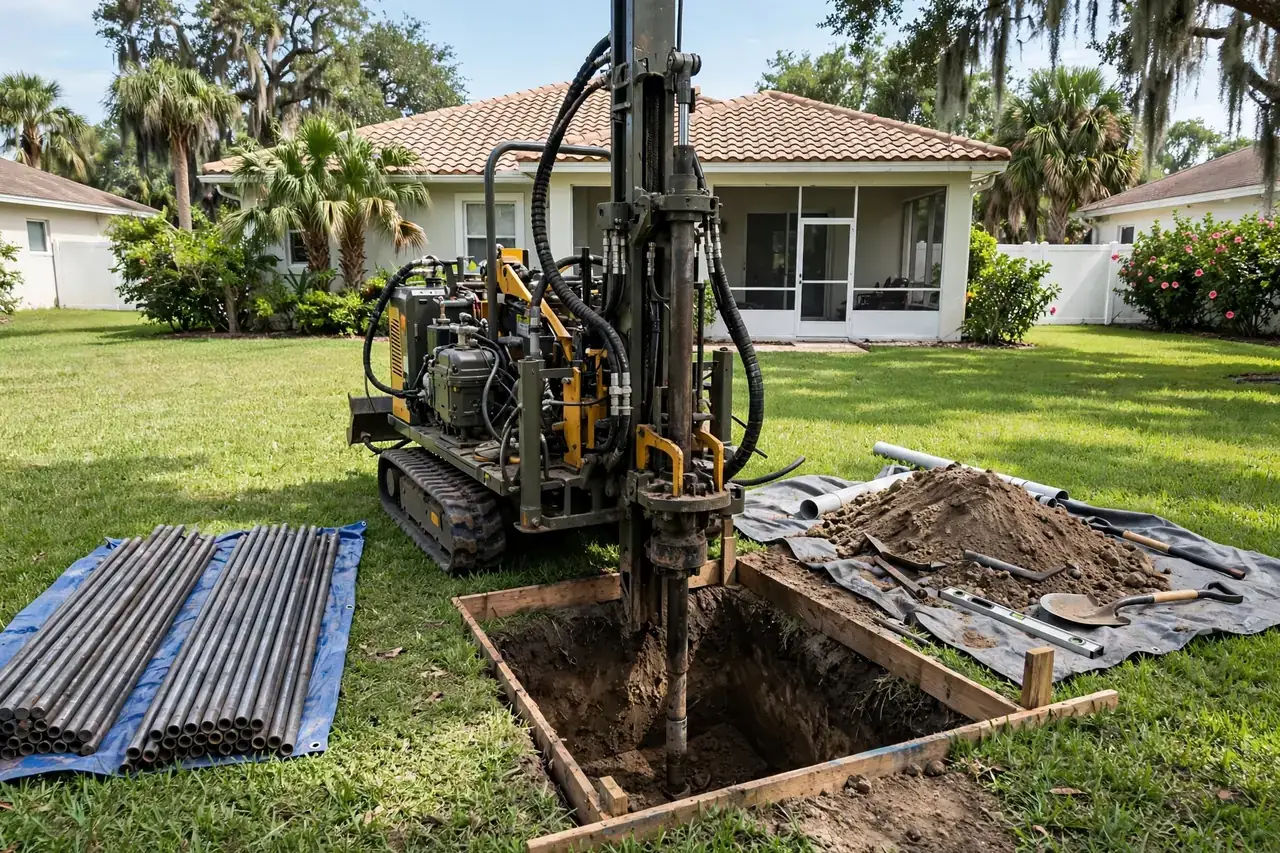
Trenchless sewer repair changes that equation. Instead of exposing the whole line, trenchless methods work through one or two small access points. The new pipe is either pulled through the path of the old one or formed inside it. The ground above the line stays largely undisturbed, which matters enormously in a place like Sarasota, where the soil is loose sand and the water table can sit just a few feet below the surface.
The phrase "no-dig" deserves a small honesty note. Trenchless repair is minimal-dig, not zero-dig. Access pits still have to be opened, typically one where the line leaves the house and one where it meets the main, and the old pipe's path still has to be located and verified. What disappears is the continuous trench: the long scar across the property that defined traditional sewer work.
There are two principal trenchless methods, and they do different jobs. Pipe bursting replaces the old pipe entirely, fracturing it outward while a new pipe is pulled into the same path. Cured-in-place pipe lining, usually called CIPP, rehabilitates the old pipe by forming a new pipe inside it. Choosing between them, or deciding that trenchless is not the answer at all, starts with seeing the inside of the line. That is why every trenchless project we take on begins with a camera inspection.
Two No-Dig Methods, Two Different Jobs
Pipe bursting is a replacement method. A bursting head, slightly larger than the old pipe's diameter, is pulled or pushed through the existing line. As it travels, it fractures the old pipe outward into the surrounding soil and pulls a brand-new, continuous pipe in directly behind it. When the pull is finished, the old pipe is gone and a new pipe occupies its path, same alignment, new material, and, if needed, a larger diameter than before. Bursting is the answer for lines that are too far gone to save: collapsed cast iron, heavily offset joints, pipe crushed by soil movement.
CIPP lining is a rehabilitation method. A flexible liner saturated with resin is inserted into the existing pipe, either inverted with water or air pressure or pulled into place, and then cured, usually with hot water, steam, or ultraviolet light. The cured liner hardens into a smooth, jointless new pipe that sits snugly inside the old one. The old pipe becomes a host; the liner becomes the working pipe. Lining is the answer for lines that are structurally serviceable but compromised: cracked pipe, leaking joints, root intrusion at the joints, internal corrosion that has not yet collapsed the wall.
The distinction matters because the wrong method on the wrong problem fails. A liner inserted into a collapsed pipe has nothing to form against. A bursting head run through a line with a severe belly, a sagging section that holds water, will simply install a new pipe that sags in the same place, because bursting follows the existing alignment. Diagnosis first, method second. Always.
When Each Method Fits
- Pipe bursting fits collapsed or badly broken pipe, lines that need upsizing, and situations where the old material itself is the problem.
- CIPP lining fits cracked pipe, leaking or root-invaded joints, and lines where the alignment and grade are still sound.
- Neither fits a line with a belly or sag, which is a grade problem that only excavation can correct, or a line with no usable access points.
You can read the full story of each method on our pipe bursting and CIPP pipe lining pages.
Camera-First Diagnosis: The Non-Negotiable Starting Point
Every trenchless job starts the same way: with an HD camera pushed through the line from an existing cleanout. The camera head carries its own light and a locating transmitter, so the technician above ground can watch the pipe's interior in real time and mark exactly where each defect sits, how many feet from the cleanout and how deep below the surface.
What the camera reveals decides everything that follows. Root masses at the joints, flaking cast-iron scale, a belly holding standing water, a separated joint after soil saturation, a section of pipe crushed flat, each of these points to a different remedy, and some of them rule trenchless methods out entirely. A belly, for example, is invisible from the surface and easy to misdiagnose as a simple clog from the symptoms alone. On camera, it is unmistakable: water ponding in a low section of pipe that no amount of cleaning will fix.
The camera also protects you after the work is done. A post-repair inspection verifies that the new pipe or liner is continuous, properly seated, and clear. The before-and-after footage is the proof that the job accomplished what it set out to do. No trenchless contractor should ask you to take the result on faith.
Our sewer camera inspection page walks through the process in detail, including what the camera finds in Sarasota's older lines and why an inspection is the smartest move before buying an older home.
Why Minimal Digging Matters in Sarasota
Sarasota's ground is not friendly to open trenches. The dominant soil is Myakka fine sand, Florida's state soil, joined in many areas by EauGallie fine sand, which drains poorly. Across much of Sarasota County, the seasonally high water table sits between zero and three and a half feet below the surface. Dig a deep, open trench in saturated sand and three things happen at once: the trench walls slough inward, groundwater seeps in and fills the excavation, and the work slows to the pace of pumps and shoring.
Trenchless methods sidestep most of that. One or two compact access pits are far easier to manage in high groundwater than a trench running the full length of a lateral. There is less soil to support, less water to pump, and far less open excavation sitting vulnerable during one of Sarasota's summer downpours. The rainy season runs June through September, delivering roughly sixty percent of the area's forty-nine to fifty-three inches of annual rain, with August the wettest month. An open trench and an August afternoon thunderstorm are a combination every contractor would rather avoid.
Then there is everything sitting on top of the ground. Sarasota properties are defined by their landscaping, mature live oaks, tropical plantings, paver driveways, pool decks, decorative walls. A continuous trench crosses all of it. Trenchless work confines the disturbance to the access pits, which means the oak stays, the pavers can be lifted and reset in a small area, and the pool deck is never touched. On the barrier islands, Siesta Key and Longboat Key, which flood repeatedly and where lots are tight, keeping the work footprint small is not a luxury. It is often the only practical way to do the job.
Sarasota Housing Eras and What They Mean for Trenchless
The pipe under your yard was chosen by the decade your home was built, and Sarasota's housing eras map neatly onto pipe materials, and onto failure patterns.
1920s to 1940s: Clay Tile in the Historic Core
Homes in Laurel Park, the Rosemary District, Gillespie Park, and the 1924 to 25 Mediterranean Revival bungalows of Burns Court typically have clay tile laterals, sometimes paired with early cast iron. Clay tile comes in short sections with a joint every few feet, and every joint is a potential entry point for roots and a potential separation point when saturated soil shifts.
1950s to 1960s: Cast Iron Arrives With the Slab
The tracts along corridors like North Tamiami Trail and in neighborhoods like Southgate brought cast-iron drainage pipe and the beginnings of slab-on-grade construction. Cast iron corrodes from the inside out; decades of wastewater flow leave the interior scaled, roughened, and eventually thinned until sections collapse.
1960s to 1980s: The Prime Failure Cohort
The slab subdivisions, Gulf Gate, Bee Ridge, and their contemporaries, combine cast-iron drain pipe buried under the concrete slab with clay or cast-iron laterals running to the street. When that under-slab cast iron fails, traditional repair means breaking open the slab inside the home. Trenchless methods, launched from access points outside the house, can replace or rehabilitate the line without touching the slab at all. This is where no-dig repair earns its keep.
1990s and Later: PVC Takes Over
From the 1990s on, in areas like Palmer Ranch east of I-75, construction transitioned to PVC and ABS, and 2000s communities like Lakewood Ranch are nearly all PVC, materials with far lower failure risk. If your home is from these eras, a camera inspection will usually confirm that the line is sound.
What Trenchless Can and Cannot Fix
An honest trenchless contractor talks as much about limits as capabilities. Here are ours.
Trenchless methods handle cracked pipe, offset joints, root-damaged joints, internal corrosion and scale (once the line is properly cleaned), and collapsed sections, bursting replaces the collapsed pipe outright, while lining needs an intact-enough host to form against. They handle lines under slabs, under driveways, and under mature landscaping, which is precisely where Sarasota's failure-prone cast iron tends to live.
What trenchless cannot do is fix geometry. A belly, a sagging section where the pipe has lost its downhill slope, is a grade problem, not a pipe problem. Both bursting and lining follow the existing alignment, so a new pipe installed along a sagging path will sag in the same place and hold water the same way. Bellies require excavation: opening the ground, re-establishing proper slope, and laying new pipe. If a camera inspection finds a belly, we will tell you plainly that trenchless is the wrong answer. Our sewer line replacement page explains what the right answer looks like.
Access matters too. Trenchless methods need usable entry and exit points with a clear path between them. And one Sarasota-specific note: in parts of the Englewood area, thousands of homes sit on AIRVAC vacuum sewer systems, where vacuum mains cannot be cut into the way gravity mains can. Trenchless techniques designed for gravity laterals do not transfer to vacuum infrastructure. When we encounter it, we say so.
The Trenchless Process From First Call to Final Check
- The call. You describe the symptoms, backups, slow drains, gurgling, odors, wet spots in the yard. We schedule a camera inspection.
- The inspection. An HD camera travels the full line from an existing cleanout. We locate every defect, measure depths, and record the footage.
- The diagnosis. We show you what the camera found and explain which method fits, bursting, lining, or, when trenchless cannot solve it, excavation.
- The preparation. The line is cleaned, roots cut, scale removed, debris jetted out, so the new pipe or liner has a proper surface to work with.
- The repair. The bursting head pulls the new pipe through, or the liner is inserted and cured. Many residential jobs are completed in a day or two.
- The verification. The camera goes back through the finished line. You see the result: a continuous, clear, properly connected pipe.
- The restoration. Access pits are backfilled and compacted, and the surface is restored.
There are no forms to fill out and no waiting on a callback. You call (941) 344-0088, we inspect, we show you the footage, and the work proceeds from evidence, not guesswork.
Is Trenchless Right for Your Sarasota Home?
If your home dates from the 1960s through the 1980s, sits on a slab, and has mature trees anywhere near the sewer lateral, trenchless repair deserves to be the first option you investigate. The combination of aging cast iron, sandy shifting soil, and aggressive root systems is exactly the problem set these methods were developed to solve, and solving it without opening a trench across a Sarasota property is worth a great deal.
If the camera finds a belly, a line with no access, or damage beyond what no-dig methods can correct, excavation is the honest recommendation, and we will make it. Either way, the inspection comes first, the footage belongs to you, and the plan follows the evidence. Call (941) 344-0088 to schedule a camera inspection and find out which category your line falls into.
Trenchless Sewer Repair Across Sarasota
We bring trenchless sewer repair to homes throughout Sarasota and nearby Gulf Coast cities.
Related Reading
Trenchless vs. Traditional Sewer Repair: A Sarasota Guide
Trenchless vs traditional sewer repair in Sarasota: how pipe condition and soil shape the choice. Call (941) 3…
Learn more →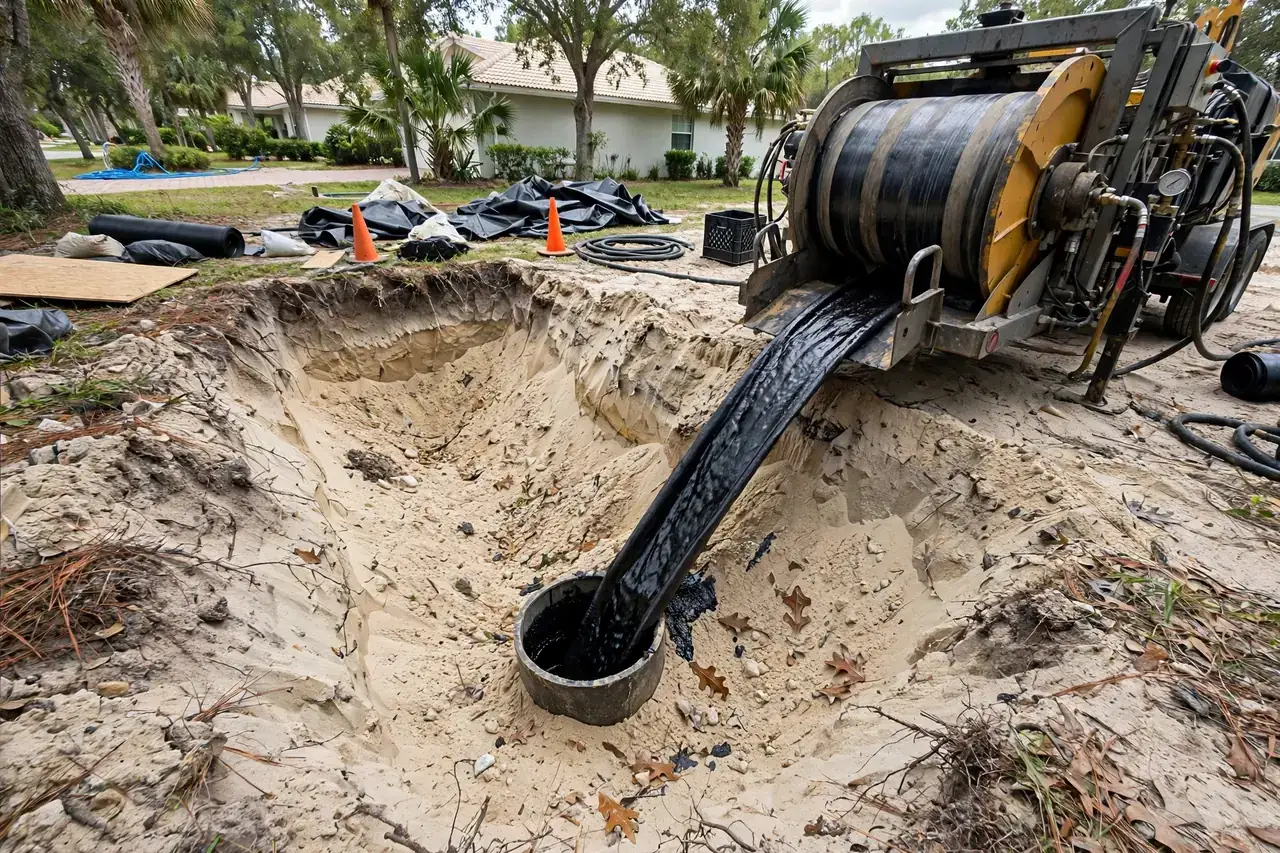
Pipe Bursting vs. Pipe Lining: Which Fits Your Sarasota Home?
Pipe bursting vs pipe lining for Sarasota homes: how each trenchless method works and when each wins. Call (94…
Learn more →Frequently Asked Questions
How long does trenchless sewer repair take?
Many residential trenchless jobs are completed within a day or two once the camera inspection and cleaning are done. Pipe bursting is typically a single-day operation. CIPP lining adds curing time but usually still finishes the same day or the next. The inspection and diagnosis happen first, so by the time work starts, the plan is settled and there are no mid-job surprises.
Does trenchless repair work on cast-iron pipes?
Yes, aging cast iron is one of the most common candidates for trenchless work in Sarasota. Cracked or corroded cast iron can be lined if the pipe still holds its shape, and collapsed cast iron can be replaced by pipe bursting, which fractures the old pipe outward and pulls a new pipe into the same path. A camera inspection shows which category your line falls into.
Will trenchless repair tear up my yard, driveway, or landscaping?
That is the point of trenchless methods: the work happens through one or two small access pits instead of a continuous trench. Lawns, plantings, paver driveways, and pool decks above the line stay in place. The pits are backfilled, compacted, and restored when the job is finished, so the visible footprint is minimal.
Can trenchless methods fix a belly in my sewer line?
No. A belly is a sagging section where the pipe has lost its downhill slope, and it is a grade problem rather than a pipe problem. Both pipe bursting and CIPP lining follow the existing alignment, so the new pipe would sag in the same place and hold water the same way. Bellies require excavation to re-establish proper slope.
Is a camera inspection really necessary before trenchless work?
Yes. The right trenchless method depends entirely on what is wrong inside the pipe, cracks, roots, offsets, collapses, and bellies each point to a different remedy, and some rule trenchless methods out completely. An inspection done without a camera is a guess, and guessing with underground pipe is how the wrong method gets installed. We never recommend trenchless work without seeing the line first.
How long will a trenchless repair last?
A trenchless repair leaves you with what is effectively a new pipe, either a continuous new pipe pulled in by bursting or a hardened liner forming a jointless pipe within the old one. Installed correctly in stable soil, it is designed for a long service life comparable to new construction pipe. Longevity depends on proper installation, correct method selection, and the condition of the surrounding soil.
Can you repair a sewer line under my home's slab without breaking the slab?
In many cases, yes. Trenchless methods launch from access points outside the home, typically a cleanout near the foundation and a pit where the lateral meets the main, so the work travels under the slab without opening it. This is a major reason trenchless repair is popular for Sarasota's 1960s to 1980s slab homes with cast-iron drain lines. The camera inspection confirms whether your line is a candidate.
What happens if my line turns out to be a poor candidate for trenchless repair?
Then we tell you so, show you the camera footage that explains why, and recommend excavation instead. Bellies, lines with no usable access, and certain soil or utility conflicts fall into this category. A full sewer line replacement re-establishes proper grade with modern pipe. It is the right call when trenchless cannot do the job.