Tree Roots in Sewer Lines: A Sarasota Homeowner's Guide
Mature live oaks and ficus trees are part of what makes Sarasota beautiful, and part of what destroys its sewer lines. Roots seek the constant moisture around buried pipe, enter through stressed joints and cracks, and turn a small defect into a full blockage. Here is how it happens and what to do about it.
Why Roots Hunt Sarasota Sewer Lines
A tree root does not know what a sewer pipe is. It knows moisture, nutrients, and oxygen, and a sewer lateral leaks all three into the surrounding soil through every defect it has. Fine feeder roots, the hair-thin exploratory roots a tree sends out by the thousands, follow moisture gradients through the soil with remarkable sensitivity. Where a joint has separated a fraction of an inch, or a crack has opened in an aging pipe, the soil around it stays damp year-round from the wastewater seeping out. To a root, that damp patch is an oasis.
Sarasota's climate supercharges this process. The long growing season means roots grow nearly year-round, and the rainy season from June through September delivers the water that fuels the fastest growth. The county's sandy soils, Myakka fine sand across much of the area, are easy for roots to penetrate, far easier than the heavy clays of other regions. And the signature trees of Sarasota neighborhoods are exactly the wrong neighbors for old pipe: mature live oaks with broad, aggressive root systems, and ficus trees whose roots are famously opportunistic about finding water.
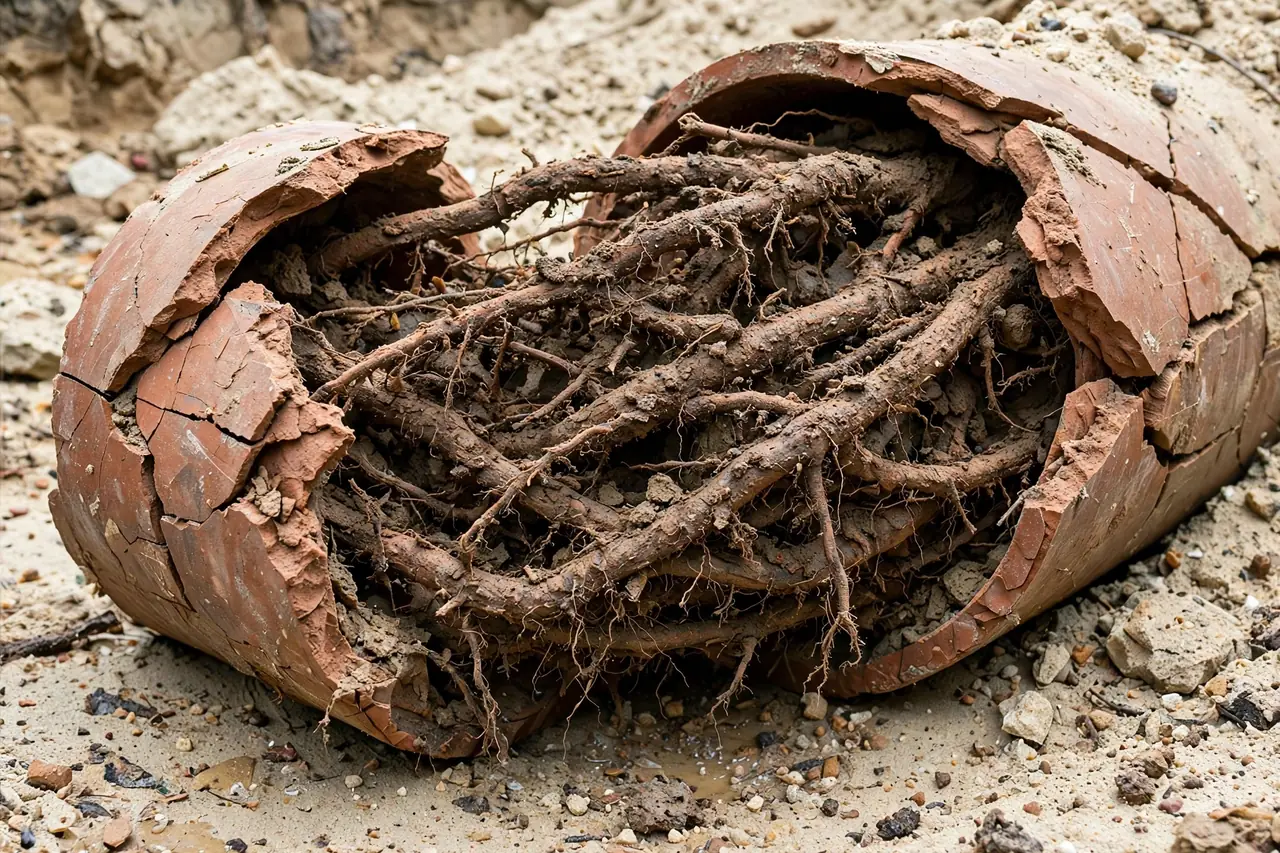
The crucial point that homeowners often get backwards: roots do not break healthy pipe. They enter pipe that is already damaged. A separated joint, a cracked clay tile, a corroded cast-iron connection, the defect comes first, from soil movement, age, or corrosion, and the roots follow. Once inside, though, roots become the primary destructive force. They branch and thicken inside the pipe, catch solids and paper, and grow with enough hydraulic pressure to widen the defect that let them in. What started as a hairline entry point becomes a shattered joint, and what started as a maintenance issue becomes a structural failure.
Clay and Cast-Iron Joints: The Entry Points
To understand root intrusion, you have to understand joints, because roots almost always enter at joints rather than through the middle of a pipe section. Sarasota's housing stock gives roots two classic pipe materials to work with, and each fails at its joints in its own way.
Clay Tile Laterals
Homes from the 1920s to 40s historic core, Laurel Park, the Rosemary District, Gillespie Park, and the 1950s to 60s tracts along the North Tamiami Trail corridor commonly have clay tile laterals: short pipe sections joined every few feet with rigid connections. Clay itself is nearly indestructible; the joints are the weak link. Decades of soil movement in saturated sand work those joints loose, and each separated joint is a doorway. A clay lateral with fifty joints has fifty potential entry points, which is why clay is the classic root-intrusion pipe and why camera inspections of clay lines so often find roots at multiple joints along the run.
Cast-Iron Pipe
The 1960s to 80s slab subdivisions, Gulf Gate, Bee Ridge, and their contemporaries, carry cast-iron DWV under the slab and clay or cast-iron laterals in the yard. Cast iron has fewer joints than clay, but corrosion thins the metal at the joints first, and external pressure from shifting saturated soil opens them over time. Under-slab cast iron is somewhat protected from roots by the slab itself, but the yard lateral, running from the house to the street through landscaping, sits directly in the root zone of every tree on the property. A mature live oak planted twenty feet from the lateral in 1975 has had fifty years to find it.
In both cases, the rainy season accelerates the cycle. Saturated soil shifts joints further apart, storm-driven root growth pushes more feeder roots into the soil, and the combination means that a joint that was merely stressed in May can be fully invaded by September. This is why root-related backups in Sarasota so often arrive with the summer storms.
Warning Signs of Root Intrusion
Root intrusion has a distinctive symptom profile, and it differs from plain clogs in ways worth knowing. The hallmark is the recurring blockage at lengthening intervals: the line is cleared, drains fine for months, then blocks again in roughly the same place. Each clearing buys less time than the last, because the root mass regrows faster into a pipe it has already mapped. If you have had the same line cleared twice and the plumber mentioned roots, you are watching this cycle in real time.
Toilets that gurgle when the washing machine drains, or a shower that fills slightly when a toilet flushes, point to a partial main-line obstruction, and roots are the most common partial obstruction in older Sarasota neighborhoods. The blockage is rarely complete at first; water seeps through the root mass slowly, which is why the fixture drains eventually but badly. Complete stoppages come later, when the root ball has had another season to grow.
Seasonal timing is another clue. Backups that first appear or worsen during the rainy season, June through September, fit the root pattern, because that is when both root growth and soil shifting peak. And if your property has mature live oaks or ficus trees within the likely path of the lateral, the circumstantial case is strong before a camera ever goes in. None of these signs prove roots on their own. But together they describe root intrusion so reliably that the sewer camera inspection that follows is usually confirmation, not discovery.
How a Camera Confirms Root Damage
A sewer camera inspection is the definitive diagnosis for root intrusion, and the footage is unmistakable. Fine white feeder roots appear first as hairlike strands entering through a joint, waving in the flow like seaweed. As the invasion advances, the camera shows thicker woody roots, then full root balls, dense masses that fill the pipe's cross-section and catch everything passing through. The camera operator can see exactly which joints are breached, how many entry points exist, and whether the pipe around them is still structurally sound or has been deformed by root pressure.
What the camera reveals beyond the roots themselves is what drives the repair decision. Roots at one joint in an otherwise sound pipe are a different problem from roots at six joints in a line with offset sections and bellies. The camera also shows what the roots have been catching: the silt, scale, and debris that accumulate behind a root mass tell their own story about how long the intrusion has been narrowing the pipe. And the locating transmitter in the camera head maps every defect's position and depth from the surface, so the repair plan targets the actual damage instead of guessing.
This is the step that separates professional root work from repeated emergency calls. Clearing roots without scoping the line is like mowing weeds without looking at the garden, you will be back. The footage, kept on file, becomes the baseline for every future decision about that line: clear it again, line it, or replace it. A dedicated tree root removal service should always start here, because the treatment depends entirely on what the camera finds.
Cutting vs. Lining vs. Replacement
Once the camera has mapped the intrusion, there are three levels of response, and they are not interchangeable. Each answers a different severity of the problem.
Cutting: Clearing the Immediate Blockage
Mechanical cutting or hydro-jetting with a root-cutting head removes the root mass from inside the pipe and restores flow. For light intrusion at a single joint in an otherwise sound line, a cutting pass can be all that is needed for a long time, it becomes part of the line's maintenance, repeated every year or two. But cutting is honest maintenance, not a cure. It does not remove the roots growing against the outside of the pipe, it does not seal the entry point, and in Florida's climate the regrowth typically follows within a season or two. Cutting buys time. It does not buy a new pipe.
Lining: Sealing the Entry Points
Cured-in-place pipe lining is the permanent answer for lines where the pipe is still structurally sound but the joints are breached. After the roots are cut and the line is cleaned, the liner is installed and cured into a smooth, jointless new pipe inside the old one. No joints means no entry points, the roots outside the pipe can press against it all they want, but there is nowhere to get in. Lining is the right call when the camera shows root entry at multiple joints in a line that is otherwise round and continuous, which is exactly the profile of many Sarasota clay and cast-iron laterals.
Replacement: When the Pipe Is Done
Some lines are past what lining can host. Roots that have grown for years can deform pipe sections, collapse clay tile, or shatter joints beyond the point where a liner can bridge them. When the camera shows structural failure, not just entry points but destroyed pipe, the answer is replacement, either by pipe bursting along the old path or by conventional excavation. Replacement ends the root problem completely for that run, because the new pipe goes in jointless or with modern sealed joints and the old entry points are gone.
The honest progression most Sarasota homeowners follow: cut first to restore flow, scope to understand the damage, then line or replace based on what the pipe looks like. Skipping the scope and cutting forever is the expensive version of the same problem, paid in emergency calls.
Keeping Roots Out After Treatment
After a lining or replacement, the new pipe is jointless and highly resistant to root entry, but the trees are still there, and good habits keep it that way. The single most useful habit is a camera recheck every couple of years. It is quick, non-invasive, and it catches any new issue, a connection at the property line, a shift at a fitting, while it is still small. Think of it the way you think about servicing an air conditioner: routine attention on a schedule, not emergency attention on a failure.
Landscaping decisions matter going forward. If you are planting new trees, keep thirsty, aggressive-rooted species well away from the known lateral path, and if you do not know the lateral's path, the locate from your last camera inspection will tell you. Existing mature trees near the line are not an emergency after a proper repair, but they are a reason not to skip the recheck schedule.
One caution about chemical root treatments: copper sulfate and foaming root killers are sold as do-it-yourself answers to root intrusion, and they do kill the roots inside the pipe, temporarily. They do not seal the entry point, they can harm the tree you may want to keep, and repeated use raises environmental questions in a county where the water table sits feet below grade. Used as a stopgap between professional visits they have a place; used as the plan, they are just a slower version of cutting forever. The permanent fix is always the same: remove the entry points, and the roots have nowhere to go.
Published 2026-10-09 · Sarasota Sewer Specialists
Related Sewer Services
Tree Root Removal
Tree root removal for Sarasota sewer lines: cutting, jetting, and camera verification for live oak and ficus r…
Learn more →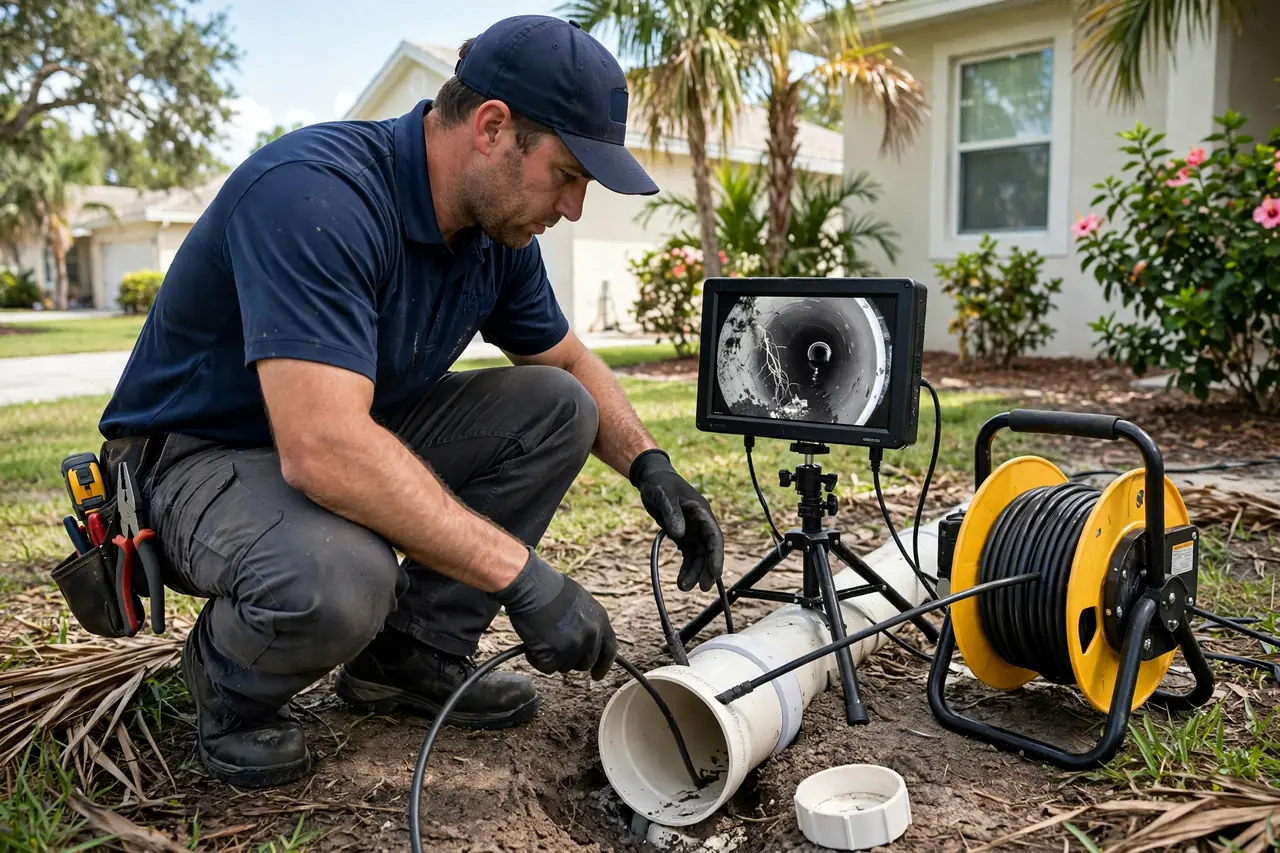
Sewer Camera Inspection
Sewer camera inspection in Sarasota, FL finds roots, scale, bellies & breaks before you dig. HD video diagnosi…
Learn more →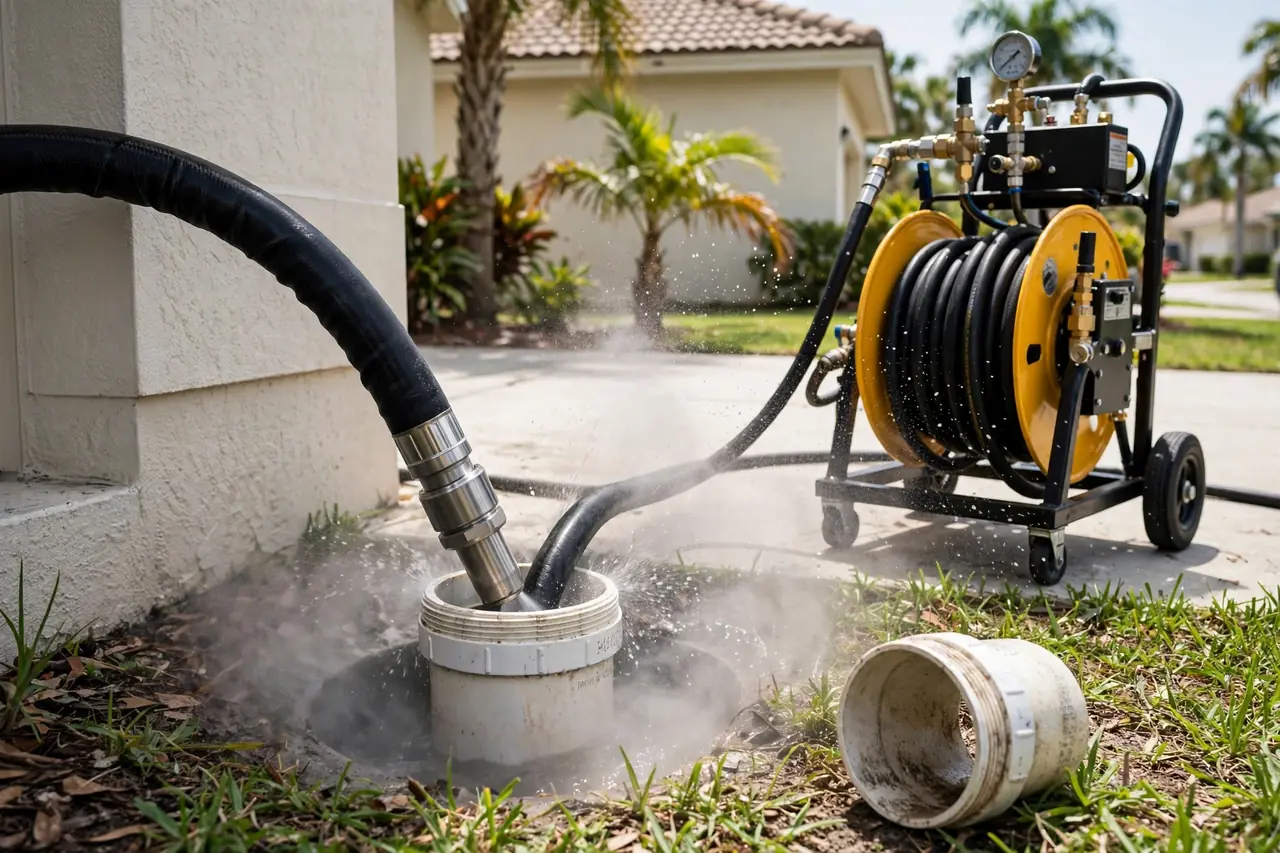
Hydro Jetting
Hydro jetting in Sarasota, FL clears grease, scale, and sand with pressurized water. Camera inspection first. …
Learn more →Nearby Service Areas
Frequently Asked Questions
Do tree roots break sewer pipes, or do they enter pipes that are already damaged?
Roots enter through existing defects, separated joints, cracks, and loose connections, not through sound pipe. Mature live oaks and ficus trees in Sarasota send fine feeder roots toward the constant moisture around a sewer line, and the finest root hairs can thread openings you would need a magnifier to see. Once inside, the roots branch, thicken, and catch everything that flows past. The pipe was damaged first; the roots are what finish it off.
Are clay or cast-iron pipes more vulnerable to roots?
Both, in different ways. Clay tile laterals have a joint every few feet, and each joint is a potential entry point once the soil shifts, which is why clay is the classic root-intrusion pipe. Cast iron has fewer joints, but corrosion and external soil pressure open them over time. In Sarasota's 1960s to 80s slab neighborhoods, cast-iron DWV under the slab plus clay or cast-iron laterals in the yard give roots two materials to work with.
Does cutting roots out of the line solve the problem permanently?
Mechanical cutting clears the immediate blockage and restores flow quickly, but it does not remove the root mass growing against the outside of the pipe or seal the entry point. Regrowth typically follows within a season or two in Florida's climate. Cutting is maintenance, not a cure, it buys time while you plan the permanent fix, and for some lines with light intrusion it is all that is needed for years.
How are roots removed from a sewer line?
Hydro-jetting with a root-cutting nozzle is the standard clearing method: high-pressure water with a specialized head shreds the root mass and flushes it out without the pipe damage that aggressive mechanical blades can cause on old, thin pipe. For heavy root balls or roots that have deformed the pipe, jetting may be step one before lining or replacement rather than the final answer.
How do I keep roots out of my sewer line after a repair?
Do not plant thirsty, aggressive-rooted trees near a known lateral path, and keep new plantings well clear of the line. For existing mature trees, the practical answer is monitoring: a camera inspection every couple of years shows whether roots are re-entering. If the line has been lined or replaced, the new jointless pipe is far more resistant, but the tree is still there, so keep the inspection habit.